
For international companies looking to expand into Thailand without setting up a local legal entity, an Employer of Record (EOR) Thailand is currently the most popular solution. However, hiring through a third party involves nuanced legal requirements. Improper management can lead to heavy fines or labor disputes.
This article explores 5 critical legal areas you must verify before partnering with an Employer of Record Thailand to ensure your business remains secure and sustainable.
5 Things Foreign Companies Must Know About EOR Regulations in Thailand
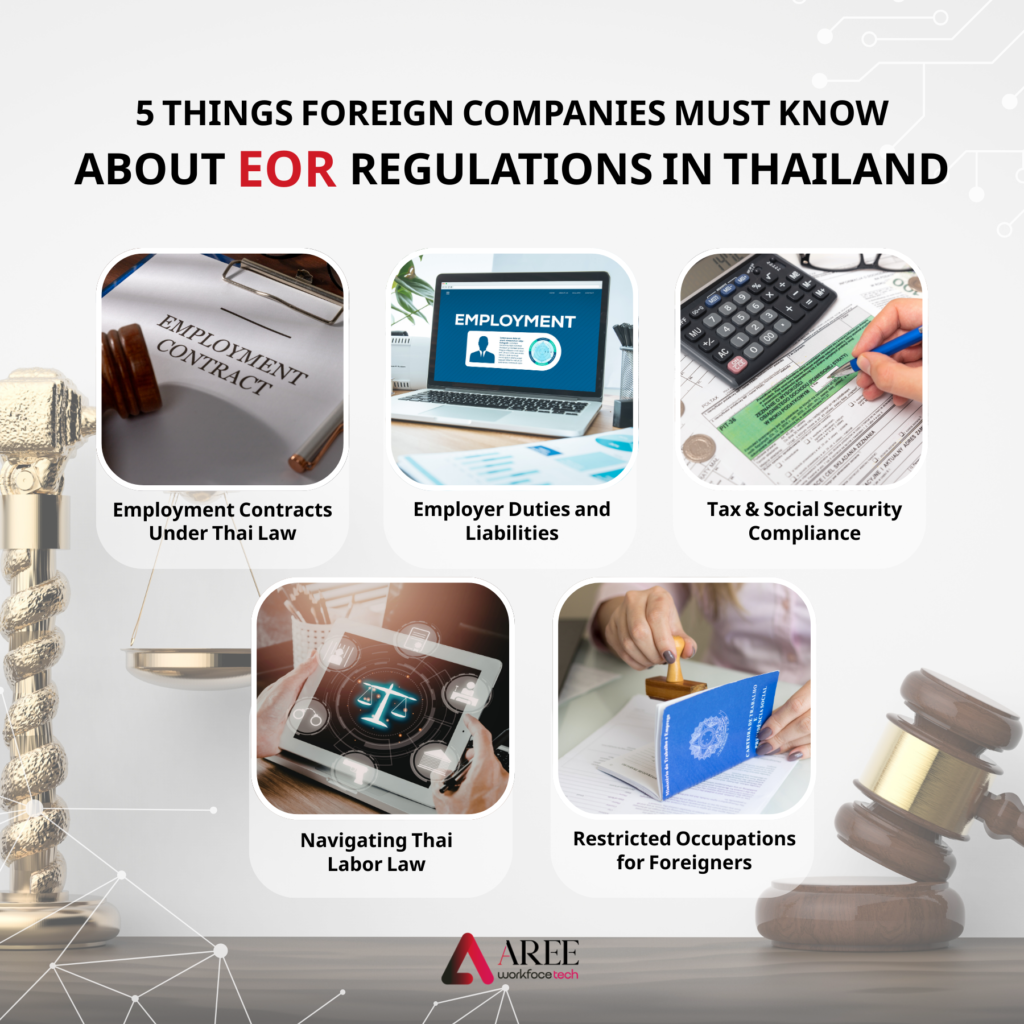
1. Employment Contracts Under Thai Law
Even though employees perform tasks for your company as a “Client,” legally, the employment contract must exist solely between the employee and the EOR Thailand provider.
- Requirements: Contracts must comply with the Civil and Commercial Code and the Labor Protection Act.
- Language: It is highly recommended to have bilingual contracts (Thai and English) for absolute clarity and full legal enforceability.
2. Employer Duties and Liabilities
When you engage an Employer of Record PEO, the provider becomes the “Legal Employer” and takes on several statutory responsibilities:
- Maintaining employee registers and mandatory employment documentation.
- Ensuring basic welfare benefits as stipulated by law.
- Managing workplace occupational health and safety standards.
3. Tax & Social Security Compliance
A core feature of Employer of Record payroll services is managing statutory deductions and contributions:
- Personal Income Tax (PIT): The employer must calculate, withhold, and remit PIT to the Revenue Department monthly.
- Social Security Fund (SSO): Mandatory contributions from both the employee and employer at rates prescribed by law.
- Workmen’s Compensation Fund: Annual contributions to protect employees in case of work-related injuries.
4. Navigating Thai Labor Law
Thailand has strict labor protection laws. A reliable EOR Thailand service must help you manage:
- Working Hours & Holidays: No more than 8 hours per day, and at least 6 days of annual leave (after one year of service).
- Severance Pay: In cases of termination without fault, employers must pay severance based on the duration of employment, ranging from 30 to 400 days of wages.
- Fair Termination: Following proper legal warning procedures and providing clear, lawful reasons for dismissal.
5. Restricted Occupations for Foreigners
If you intend to use an EOR to hire expats in Thailand, you must consider the “Emergency Decree on Non-Thais’ Working Management”:
- Prohibited Jobs: Many occupations are reserved strictly for Thai nationals (e.g., agriculture, certain construction roles, or specific artisanal crafts).
- Work Permits: Professional providers like Aree Workforce Tech handle the entire Visa and Work Permit process, ensuring it aligns correctly with your business category.
Comparing Employer of Record Cost and Value
When evaluating Employer of Record cost, look beyond the monthly service fee. Consider the “Risk Mitigation” value compared to DIY setup.
| Factor | DIY (Setting up an Entity) | Using EOR Thailand |
| Setup Time | 3 – 6 Months | 48 – 72 Hours |
| Initial Costs | Very High (Registration/Office) | Low (Pay-per-head) |
| Legal Expertise | Must hire own Legal/Accounting teams | Managed by on-hand experts |
| Flexibility | Low (Difficult to liquidate) | High (Scale up/down instantly) |
EOR Thailand is the ultimate shortcut for international firms to operate legally in Thailand without a local entity. It covers everything from employment contracts and taxes to strict compliance with the Labor Protection Act.
Having an expert partner minimizes the risk of disputes and massive fines. Aree Workforce Tech acts as your consultant, managing every step of the hiring process so you can focus entirely on your expansion. Step into the Thai market with confidence using our modern, world-class workforce solutions.