

In the competitive landscape of 2026, global technology firms are facing a dual challenge: the escalating cost of specialized talent in Western markets and the relentless pressure to maintain high-speed innovation. While the “War for Talent” continues in Silicon Valley, London, and Berlin, a new frontier of Strategic Arbitrage has emerged in Southeast Asia that why Employer of record thailand is importian.
International tech founders and CFOs are increasingly looking toward Thailand—not just as a travel destination, but as a high-performance hub for remote engineering. This guide explores how leveraging a Employer of Record Thailand allows global firms to capitalize on the unique intersection of currency advantage and world-class technical expertise.
Understanding Strategic Arbitrage in the 2026 Tech Economy
The term “Arbitrage” in the labor market refers to the practice of taking advantage of the price difference between two markets. In 2026, this has evolved into a strategic move for tech companies. By hiring in Thailand, firms can secure the same level of output found in high-cost cities but at a significantly optimized cost structure due to the favorable exchange rate and lower local cost of living.
The Currency Advantage
While major Western currencies like the USD, EUR, and GBP remain strong, the Thai Baht (THB) offers a unique “Purchasing Power Parity” (PPP) advantage. A salary that would be considered “entry-level” in San Francisco allows an international firm to hire a Top 1% Senior Developer in Thailand. This doesn’t mean paying “cheap” wages; it means paying a premium local salary that is still 50-60% lower than Western benchmarks.
Beyond Cost: The Quality of Thai Tech Talent
A common misconception among global firms is that lower cost equates to lower quality. However, 2026 data shows that Thai tech talent is now on par with international standards, particularly in specialized fields.
The Rise of “Global-Ready” Engineers
Thailand’s tech ecosystem has matured rapidly. Today’s Thai developers, data scientists, and AI researchers are often:
- International Graduates: Many have studied or worked abroad, bringing a global perspective to local operations.
- Tech-Stack Versatile: Proficient in the latest frameworks—from Rust and Go for backend systems to Flutter and React for mobile/web interfaces.
- Communication Proficient: The 2026 workforce in the Thai tech sector has seen a massive surge in English proficiency, driven by years of remote collaboration with global firms.
Specialized Skill Availability
Thailand is currently a hotspot for:
- AI & Machine Learning: Development of localized LLMs and AI-driven automation.
- Fintech & Blockchain: Leveraging Thailand’s position as a leader in digital payment adoption.
- Cybersecurity: High-level threat intelligence and compliance specialists.
Remote Infrastructure: Thailand’s 2026 Digital Readiness
For remote hiring to be successful, the infrastructure must be flawless. Thailand has invested heavily in its digital backbone, making it a premier destination for distributed teams.
- World-Class Connectivity: Thailand consistently ranks among the top countries for fixed broadband speeds. In 2026, 5G coverage is ubiquitous, ensuring that remote workers remain connected even outside major cities like Bangkok or Chiang Mai.
- Co-working Ecosystem: The rise of professional co-working spaces across the country provides a stable environment for remote talent to maintain high productivity.
- Time Zone Management: While there is a time difference, many Thai tech professionals have adopted “Asynchronous Communication” or flexible hours to align with Western “Stand-up” meetings, creating a “Follow-the-Sun” development model.
The Legal Bridge: Navigating Compliance with an Employer of Record Thailand
One of the biggest hurdles for international firms—whether they have a local entity or not—is the complexity of Thai labor laws and tax regulations. This is where an Employer of Record Thailand (EOR) becomes indispensable.
For Firms WITHOUT a Thai Entity
An EOR acts as the legal employer on your behalf. They handle everything from:
- Statutory Compliance: Ensuring all contracts follow the Thai Labor Protection Act.
- Tax & Payroll: Managing PND.1 (Withholding Tax) and Social Security (SSO) contributions, which in 2026 have been updated with new ceilings.
- Benefits Administration: Managing local health insurance and provident funds.
For Firms WITH an Existing Thai Entity
Even firms with a local presence often use an EOR or Payroll Outsourcing Thailand to streamline their operations. It allows the core team to focus on product development rather than navigating the intricacies of local bureaucracy, such as the Workmen’s Compensation Fund (WCF) and annual tax filings (50 Tawi).
A Comparative Financial Simulation (2026 Data)
To illustrate the strategic arbitrage, let’s compare the hiring of a Senior Full-Stack Developer:
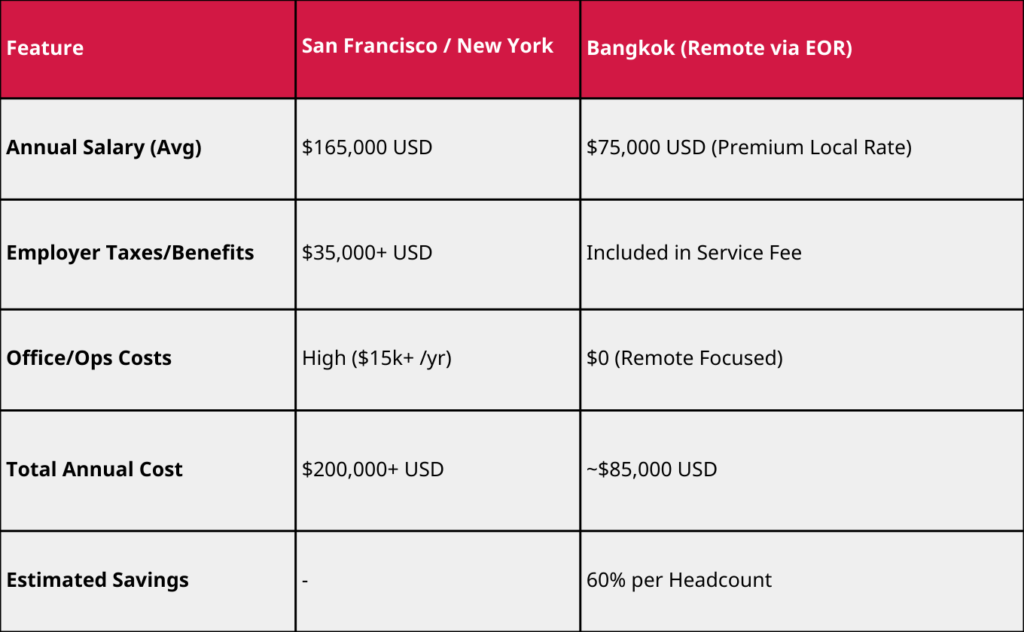
Note: By offering $75,000 USD in Thailand, you are paying nearly 3x the local average, allowing you to hire the absolute best talent in the country.
Integrating High-Tech Employee Experiences
Tech talent in 2026 expects a digital-first experience. To bridge the “Distance Gap,” leading firms utilize an Employee Self-Service (ESS) App. This technology ensures that even though the employee is working remotely for a global firm, their administrative experience is seamless:
- Digital Payslips: Instant access to income statements.
- Leave Management: Simple mobile-based requests for time off.
- Expense Claims: Real-time digital submission for rapid reimbursement.
The Thai Tech Talent Pool: A Deep Dive into 2026 Demographics
To truly understand the “Strategic Arbitrage” of hiring in Thailand, international firms must look at the density and diversity of the local tech talent pool. In 2026, Thailand has moved from being a general service economy to a specialized digital hub.
Tech Talent Density in the Population
As of early 2026, Thailand has a total population of approximately 71.8 million, with a robust labor force of about 40.2 million.
- Tech Workforce Size: The specialized ICT and digital workforce accounts for approximately 1.2% to 1.5% of the total labor force, equating to roughly 480,000 to 600,000 professionals.
- Future Pipeline: The government’s “4D Policy” aims to add another 280,000 tech roles by 2029, particularly in AI, Semiconductors, and EV technology.
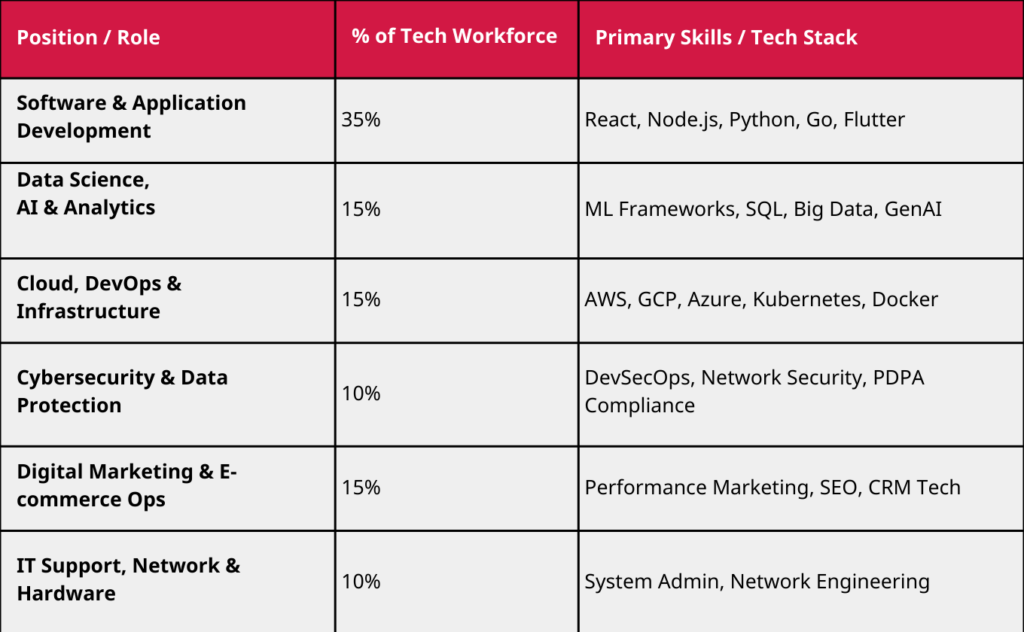
Breakdown by Tech Specialization (Estimated Distribution)
The Thai tech talent pool is diverse, with a strong emphasis on full-cycle development and emerging data sciences:
Gender Diversity: A Regional Leader in Women in Tech
One of the most compelling reasons to hire in Thailand is its high gender diversity in the technology sector, which consistently outperforms global benchmarks.
- Overall Tech Gender Split: * Male: ~65%
- Female: ~35% (Note: This is significantly higher than the global average of ~25-28%).
- Women in STEM Education: Thailand is a regional leader, with female enrollment in STEM and engineering courses nearing 50% in top-tier universities.
- Leadership Roles: Women in Thailand hold approximately 38% of management positions across all sectors, a trend that is rapidly translating into senior technical leadership and CTO roles in the tech industry.
Conclusion: The Future of Distributed Tech Teams
Strategic arbitrage is no longer about finding the “cheapest” labor; it is about finding the “most efficient” talent. Thailand in 2026 offers a rare combination of high-level technical competency, robust digital infrastructure, and a cost-effective economic environment.
By utilizing an Employer of Record Thailand, international tech firms can bypass the risks of non-compliance and the delays of entity setup. They can start building their “Thai Tech Hub” within days, securing the talent they need to scale globally while significantly optimizing their burn rate. In the 2026 economy, the bridge to success is built on local expertise and global vision.